

Research
At the Mars Desert Research Station (MDRS) analog facility, our crews carry out scientific research to study the feasibility of a mission to Mars.
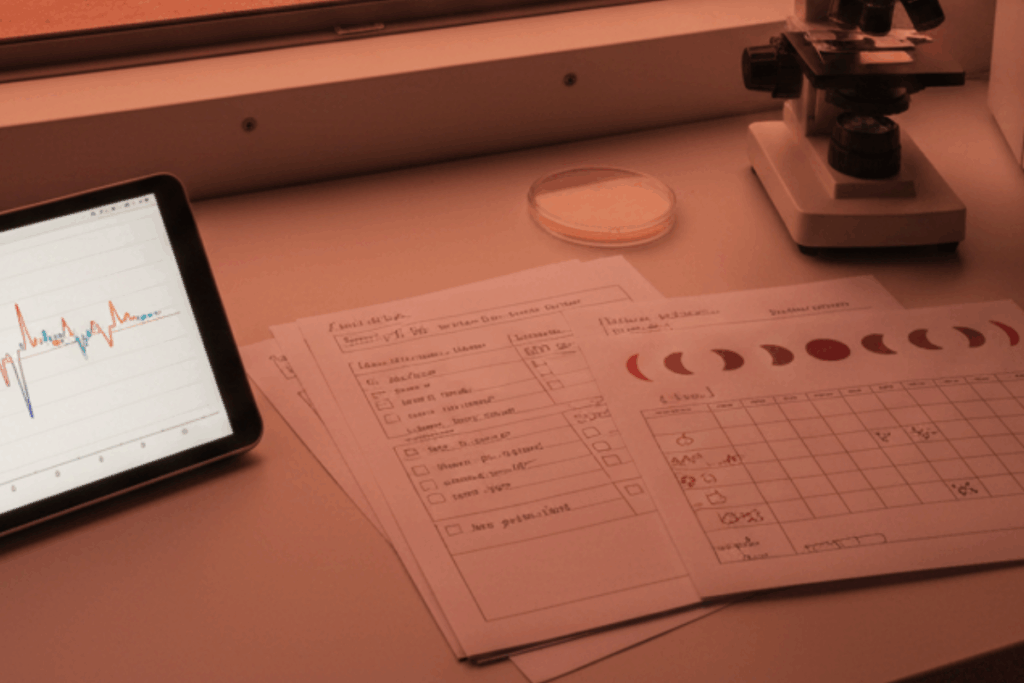
Menstrual Regulation and Ovarian Cycle in a Female Crew During a Mars Analog Mission
This study investigates how isolation, confinement, and environmental stressors typical of an analog mission may affect the menstrual cycle of the all-female Hypatia I crew during their Mars simulation at the Mars Desert Research Station. Questionnaires completed before and during the mission collected data on cycle regularity, bleeding duration and volume, associated symptoms, and emotional factors. The goal was to identify potential changes in ovarian function, understand how living in extreme environments influence the menstrual cycle, and provide insights for menstrual health and female wellbeing during long-duration space missions.

 Hypatia I

Optimizing Team Communication and Cooperation with Sociomapping®
The Hypatia I crew partnered with Sociomapping® to analyze and optimize team dynamics. Using pre-mission and in-mission questionnaires, the study mapped communication patterns, interdependence, and trust among the seven crew members. It identified key relationships, collaboration needs, and potential bottlenecks, revealing how effectively the team communicates, coordinates, and supports each other. These insights inform strategies to strengthen cooperation, improve performance, and foster resilient, high-functioning teams capable of long-term success in complex, high-stakes environments.
Hypatia I
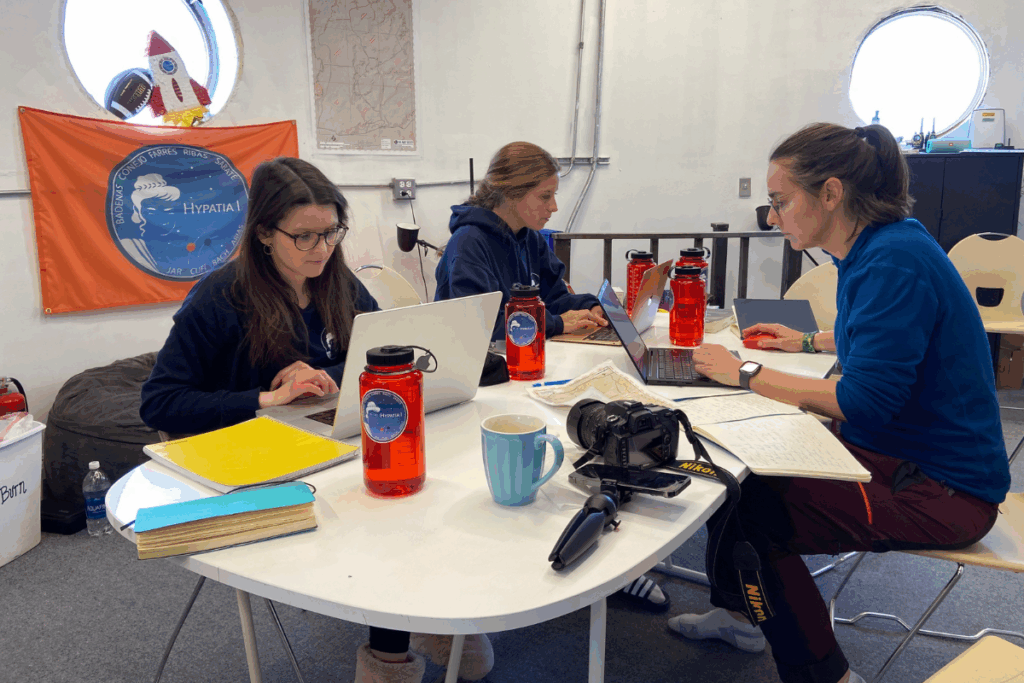
Psychological Adaptation in Extreme Environments: Insights from a Mars Simulation
This project is part of a larger initiative exploring how individuals and groups adapt psychologically to isolated and confined extreme (ICE) conditions during a Mars simulation. Conducted at the Mars Desert Research Station, the study monitored the Hypatia I crew through daily questionnaires assessing stress, work pressure, exhaustion, coping strategies, recovery processes, satisfaction, emotional states, and sleep. Results reveal how coping strategies, emotions, and defense mechanisms interact to support adaptation, providing valuable insights into individual, social, and organizational responses. These findings contribute to preparing and supporting astronauts for long-duration space missions by enhancing understanding of psychological resilience in extreme environments.
Hypatia I

Surface Deformation Monitoring at Mars Analog Research Station Using InSAR Techniques
Understanding surface deformation is essential for ensuring the safety and sustainability of analog habitats and for informing future Mars exploration missions. Mars analog research stations offer unique Mars-like environments for testing and validating advanced monitoring techniques under conditions similar to those on planetary surfaces. This project will apply Interferometric Synthetic Aperture Radar (InSAR), a cutting-edge satellite remote sensing method capable of detecting ground movement with millimeter-level precision. Using Sentinel-1 satellite data and natural persistent scatterers, this project aims to generate high-precision deformation maps to assess site stability. Additionally, it will incorporate analyses of environmental variables to better understand their effects on ground stability and observed deformation patterns.
Hypatia III

Strengthening Global Partnerships to Advance Science and Technology with Hypatia
Space science and technology thrive on global collaboration. Maximizing Hypatia’s mission is also about building strong international partnerships that amplify the impact of our mission. Through this project, we will be connecting with organizations and individuals worldwide, from scientists and engineers to artists and educators to collaborate on science and technology initiatives. This project invites researchers and innovators from diverse backgrounds and from all over the world to contribute their expertise and work, ensuring that the benefits of Hypatia’s work reach teams across the globe and across disciplines.
Hypatia III

Letters from the Moon: Lessons from Astronauts for Everyday Human Growth
This book explores the intensive training and everyday life experiences of analog astronauts. Psychological resilience, mental health, teamwork, adaptability and coping with isolation are major themes. Drawing on theories such as Stoicism and Cognitive Behavioral Strategies, it explores how people develop mental resilience and cope with extreme environments. Through diary and mission records, and interviews with professional astronauts, the book provides an intimate, day-by-day look at coping with stress, conflict, adaptability and teamwork in high-pressure situations. Combining personal testimonies with findings from psychology, it distills techniques applicable by anyone to stay afloat despite adversity, to improve teamwork, and build resilience in daily life.
Hypatia III

Spiritual Health and Perceived Well-Being in Space Crews: A Qualitative Exploration
In 2013, the WHO recognized spirituality as a key dimension of health, essential for finding meaning, purpose, and resilience. This project, Human Survival in Extreme Environments, aims to explore the meaning of spiritual health needs of space crew members and how participation in real or simulated space missions influences the crew’s spiritual health and performance. These environments, marked by extreme temperatures, oxygen scarcity, radiation, toxicity, or isolation, demand adaptive responses that challenge human limits. Conducted by the University of Barcelona’s Chair of Spiritual Health and Humanization, this study will offer insights into the relationship between spiritual health, perceived well-being, and performance, with potential applications in other extreme contexts.
Hypatia III

Simulating reduced gravity through 6° inclined sleep
Mars has about 38% of Earth’s gravity, causing reduced but significant effects on the human body, including fluid shifts, sleep disruption, and cognitive changes. The project discusses how sleeping with a tilted position can model some of the body’s responses to reduced gravity. The subjects are to sleep with a 6° head-down tilt (HDT), a method used in bed rest studies for mimicking fluid shifts and physiological responses similar to microgravity. Results would be compared to individuals sleeping in the supine position. It aims to assess sleep quality, cognitive function, and changes in well-being, while increasing public awareness on the effects of spaceflight on the human body.
Hypatia III

Poetry on Mars: Endings and Beginnings
With life on Earth no longer possible, a group of animals arrive on a new planet to settle and begin again. This poetry project, which will be a collage of poems and voices, will explore themes of memory, adaptation, and interspecies communication in the aftermath of ecological collapse. The work will also investigate what remains when language disappears, what rituals emerge after the end of civilization, and what forms of connection are still possible in the silence that follows. The poems will function both as imagined mythologies and as emotional cartographies of this new beginning, reimagining what community and care might look like in a world that has lost its former names.
Hypatia III

Fuelling the Future: How personalized nutrition shapes immunity and metabolism in space
We are living in an exciting era of biotechnology, where multi-omics technologies allow scientists to measure thousands of proteins, genes, and metabolites simultaneously, uncovering how our bodies truly function in health and disease, both on Earth and in space. This knowledge is essential for long-term space missions, where microgravity weakens muscles, immunity, and radiation accelerates aging. This project will address how diet affects biological resilience. The analogue crew will follow a growth-promoting diet followed by a growth-inhibiting diet. Blood samples will be collected at different key time points to conduct multi-omics profiling: expose samples to radiation, and assess biomarkers of immunity, muscle health, and genomic stability. The insights gained will not only help prepare humans for deep-space travel but also guide strategies to extend healthspan here on Earth.
Hypatia III

Drone-enabled habitat integrity monitoring and positioning system
Crewed space missions rely on automation to handle repetitive or hazardous tasks, allowing astronauts to focus on critical objectives. This proposal expands Hypatia’s earlier drone research to include habitat condition monitoring. Equipped with sensors such as RGB, infrared, near-infrared, or LiDAR, drones will assess habitat structural integrity, detect heat loss, and generate detailed 3D models of habitats and surroundings. In collaboration with industry partners, the project aims to provide rapid, reliable evaluations of habitat status. Additionally, the area 3D mapping will aim to be coupled with a local ground-based positioning system that will enhance crew safety and operational efficiency through precise, infrastructure-independent location tracking.
Hypatia III

Building on Mars: designing habitats with regolith-based materials Project
This project explores the development of a Martian regolith simulant clay-like construction material and a comparison of its structural properties with those of Earth concrete. The objective is to assess the practicability of regolith-based construction for Martian habitats. Aside from the science experiment, the project also has an outreach component that inspires students and the public to do the simplified experiment at home and participate in a “Design Your Mars Habitat” 3D modeling contest using real planetary data. This two-way project furthers scientific research while teaching and involving potential explorers and engineers.
Hypatia III

Temporal Evolution of the Solar Chromosphere
Hypatia I

RGBLHa Color Imaging of Deep-Sky Objects
Hypatia I

Satellite Imagery Station
The project proposes the installation of a low-cost antenna system—based on a dipole antenna, Raspberry Pi, and USB radio dongle—to receive real-time NOAA satellite images. This setup, already tested through an SGAC program, enables the astronauts to monitor weather and local terrain, connect to the SatNOGS global network, and participate in practical satellite-communication activities. Previous deployments in countries such as the Philippines, Egypt, Ethiopia, and Rwanda demonstrated the project’s success in empowering communities through hands-on space technology. At the Martian base, the project provides resources that allow space enthusiasts and the public to engage with real satellite operations, schedule satellite pass downloads, and participate in educational events. It also aims to build a global community through webinars, outreach, and support for additional antenna installations, contributing to broader awareness and participation in the space sector.
Hypatia III

Martian Workouts: Study of the Effect of Nutrition and Physical Training on Body Composition Changes in Crew Members
This project investigates changes in body composition in the analog astronauts of the Hypatia II mission at the Mars Desert Research Station (MDRS), with the objective of developing and refining protocols for monitoring physiological adaptations in space-analog environments. The study focuses on how factors such as isolation, physical workload, and environmental conditions influence body composition during short-duration missions that simulate interplanetary exploration. The methodology integrates pre-mission, in-mission, and post-mission assessments, combining anthropometric, physiological, and biomarker data. The crew followed a structured physical training protocol before and during the mission, validated by specialists, while individual nutritional habits were analyzed to establish a baseline aimed at maintaining a balanced intake of essential nutrients. Physiological monitoring was conducted using wearable technology and biological sample analysis to provide a comprehensive view of body composition dynamics under space-analog conditions. This study aims to contribute to the development of robust and reproducible methodologies for body composition monitoring in simulated space missions, supporting the design of countermeasure strategies for future long-duration exploration missions.
Hypatia II

Astrophotography on Mars
This project aims to capture images of the Martian sky for scientific outreach and astronomical education purposes, targeting a broad audience that includes students, educators, astronomy enthusiasts, and the research community. The observations were carried out using a 16-inch RCOS Ritchey–Chrétien telescope, an instrument particularly well suited for deep-sky observations thanks to its high-resolution optics and advanced tracking systems, which enable the acquisition of high-quality images of galaxies, nebulae, and star clusters.
One of the main objectives is to bring the exploration of deep space beyond Earth closer to the public through astrophotography, using celestial objects with popular and evocative names as a means of engagement. Through these images, the project seeks to foster interest in scientific research, facilitate the understanding of astrophysical processes such as star formation and galactic evolution, and promote the use of real observational data in educational environments.
Hypatia II

Macro art by Satellite
Hypatia II

Monitoring the female body under semi-extreme conditions
The female body and its reaction to extreme or semi-extreme conditions is not well understood. Studies on human factors have typically been centered on male body. There is a lack of information and data regarding female body behaviour under certain extreme conditions that astronauts have to face in their missions, and more in particular during the space walks or extra vehicular activities (EVA).The MDRS is a perfect place to carry out a study like this and gather data from the analog astronauts that can be analysed by Human Factor research centres such as the Barcelona Institute of Global Health (ISGlobal) .
This study was be carried out during the MDRS crew 310 mission (Hypatia II), where the crew members weared instrumentations such as a Garmin watches, that measured vital constants like heart rate, blood pressure, body temperature, blood oxygen, etc., while performing the day to day activities and the extra vehicular activities, preferably being submitted under semi-extreme conditions. The data is being analysed by a ISGlobal Research Centre team, led by Dr. Juan Ramon González, as PI.
Hypatia II

Mapping Mars surface characteristics with drones
Drones are commonly used these days to map Earth surfaces, using different type of sensors, from optical cameras, to LIDARs. They can also be used to map Mars surface, as Ingenuity, NASA’s Perseverance helicopter drone. In this project, we will fly a drone designed to account for the Mars light atmosphere (2% of the Earth one), that will embark an optical camera dedicated to map Mars surface, or in this case, the MDRS and its surroundings.
The flight plan will be designed and the data processing developed in collaboration with the Embry-Riddle University, in Florida.
Hypatia II

Simulating Satellite Calibration orbiting Mars Using Corner Reflectors (with Sentinel-3 A&B)
Satellites orbiting Mars need to be accurately positioned, both in terms of their orbit and their location over the Martian surface. It’s also important to measure the elevation of the Martian terrain, to measure its physical parameters and to be able to map Martian surface. One of the key instruments for this purpose are radar altimeters, which measure the height of the surface below the satellite. Radar altimeters are already being used on Earth to map different types of surfaces, such as oceans, land, glaciers, and icecaps, and Earth’s gravitational field (the geoid).
Just like on Earth, Radar Altimeters are excellent candidates to map Mars’ surface, and as on Earth, Mars Observation instruments orbiting Mars also need to be calibrated to ensure accurate measurements.This project aims to use the most advanced radar techniques to calibrate Earth-orbiting satellites like the Sentinel-3 A&B, to measure Earth’s surface elevation or, equivalently, Mars surface elevation. We will install a calibration site at the MDRS, that includes a Corner Reflector and a GNSS station.
Hypatia II

The female cyclicity as a tool for self-consciousness
Hypatia II

In-Situ Analysis in Sample Return Missions: Optimizing Space Exploration
Sample-return missions are the most scientifically valuable endeavors in planetary exploration, as they return extraterrestrial material back to Earth for comprehensive and detailed laboratory investigation. The present project aims to enhance the efficiency of such missions by testing two instruments to be operated by astronauts: a handheld X-ray fluorescence gun and an energy-dispersive X-ray fluorescence (ED-XRF) spectrometer. Together, these instruments provide in-situ chemical analyses that improve the scientific quality of collected samples, rather than prioritizing the quantity. Additionally, the two instruments complement one another by bridging field studies and work in the station’s science dome, enabling precise chemical characterization and the selection of the most valuable samples for return to Earth.
Hypatia II

Cognitive Health correlations: physiological and metabolic markers
This study examines how isolated and confined environments (ICE) impact cognitive and physiological health, focusing on female astronauts during a 12-day Mars simulation at the Mars Desert Research Station (MDRS). The research aims to explore how including hormonal fluctuations linked to the menstrual cycle may affect the analytical study in correlating cognitive performance, physiological and psychological stress responses, and overall well-being. By analyzing data from wearable devices, surveys, and biomarker samples, the study aims to address gaps in understanding sex-specific health challenges in space missions.
Hypatia II, Hypatia III

Hypatia’s Circular Odisey: Tracing the sustainable path of the Hypatia II Mission
Hypatia II

Spacetatouille: Designing a 24-Hour Space Menu for Astronaut Health and Performance
In collaboration with the Space Faculty in Singapore and the winners of their 17th International Space Challenge, we explored the design of a 24-hour menu for astronauts living in space. This initiative investigates how astronauts maintain a balanced diet in microgravity, how food is prepared for space consumption, and the innovative methods used to package it for safe transport. This research evaluates nutritional science, space food logistics, and the critical role of a well-balanced diet in sustaining health and performance in extreme environments.
Hypatia II

AstroGrow: Developing Optimal Growth Mechanisms for Space and Earth-Born Tomatoes
In collaboration with the British School of Barcelona, Year 11 students, with the support of the Hypatia crew,designed a plant-growing support mechanism to ensure optimal light, water, temperature, and environmental conditions for two sets of tomato seeds. One set served as a «control» and consited of regular seeds, while the other comprised «space seeds», that had spent five weeks in spce aboard the SpaceX CRS-23 Dragon capsule. Theese seeds were part of the Tomatosphere program, which uses «space» tomato seeds to help students explore how space conditions affect plant growth. Throughout the simulation, the crew conducted regular measurements of the tomato plants to assess the effectiveness of the growing support mechanism and to gain insights into the impact of space environments on seed development.
Hypatia II

Enhancing Solar Panel Efficiency for Dusty Mars Environments
Mars presents unique challenges for solar panels due to its fine, electrostatically charged dust, which adheres stubbornly to surfaces and obstructs sunlight absorption. This accumulation reduces the effectiveness of solar panels, and over time, the abrasive dust may even scratch panel surfaces, further compromising their functionality. These issues intensify during frequent Martian dust storms, making dust management crucial for prolonged missions. Different solutions will be tested during the analog mission to maintain solar panel performance in Mars’ harsh environment, with research focused on optimal system designs, power requirements, and coating effectiveness.
Hypatia II

3D printing tools on Mars
Additive manufacturing is considered a key enabling technology for future space missions, offering increased autonomy and flexibility in environments with limited resupply capabilities. This project investigated the application of 3D printing in an analogue Martian environment at the Mars Desert Research Station (MDRS) during a 12-SOL mission. The study focused on the integration of a fused deposition modeling (FDM) 3D printer into daily mission operations to support research, engineering, and outreach activities using recycled polylactic acid (PLA) as printing material.
The project scope included the design and fabrication of structural components related to solar panel support systems, with test objects intended to evaluate resistance to environmental stressors such as wind and dust. These components were deployed externally during extravehicular activities to ensure exposure to realistic analogue conditions. In addition, the 3D printer was used to produce functional tools for geological fieldwork, enabling rapid design iteration and on-demand manufacturing in a remote and resource-limited setting. The project also incorporated an educational outreach component through the fabrication of tools designed by students as part of a design competition. Selected designs were manufactured and prepared for use in analogue mission activities, illustrating the potential of additive manufacturing as an educational and engagement tool. Throughout the mission, the printer was operated continuously to assess its integration into a simulated planetary habitat workflow and to identify operational constraints relevant to future space missions.
Hypatia II

Children Chronicle of the Hypatia II Mission
This is a children’s story that narrates the Hypatia II crew’s space mission to Mars, introducing its brave members and the exciting projects they carry out, along with the fun adventures they experience on the red planet. The book aims to inspire girls to become fearless explorers and scientists, highlighting real women close to fields like engineering, geology, astrophysics, and mathematics. At a critical stage when studies show that girls stop seeing themselves as scientists, this story showcases female role models, fostering their curiosity and showing them that science is for them too.
Hypatia II

Building Blobarium
Hypatia I

Cellular intelligence on the martian surface
Hypatia I

Martian Batteries
Since the early space missions, batteries have been essential for providing and storing electrical power on spacecraft. For Mars surface missions, the need for advanced batteries with high energy density, long cycle life, and low-temperature operation is critical, as transporting heavy solar panels and batteries from Earth is costly and logistically challenging. This research aims to develop primary batteries using locally available Martian resources, following a strategy already tested on Earth with organic and inorganic electroactive compounds. Mars’ surface is rich in iron, particularly iron oxides like ironstone, which will serve as the active material for the battery. During the stay at the Mars Desert Research Station, the project will first use commercial iron compounds and then extract iron directly from surrounding rocks. Crew urine will be used as the electrolyte, addressing water scarcity. The ultimate goal is to demonstrate a practical application by powering an LED lighting system to germinate and grow edible plants, showing how in-situ resource utilization can support life on Mars.
Hypatia I

Podcast ‘Missió Mart’, Daily reports, Articles and reports
‘Missió Mart’ is narrative podcast about the Hypatia I crew members’ scientific projects and our experience at the MDRS. A huge experience recorded with just a little microphone from a remote place.
Hypatia I

CatMart: looking for Martian life
Is there life on Mars? This question is addressed together with children in public primary schools around Catalonia. The students from La Marinada (El Masnou) were to participate in the program. During fall 2024 up to 10 schools around the region (four of them in rural areas) have participated in the CatMart program. To find the answer, the students will examine the Martian soil and analyze the presence of microorganisms. With this activity they will learn to follow a science protocol and learn about Mars exploration.
Hypatia I

Seeds for the crew
In her role of Greenhub officer, Laia Ribas was in charge of the greenhouse of the Hypatia I mission. This required performing daily tasks such as watering three times, controlling the temperature and the plants grown for future crews. Laia Ribas obtained soybean and lentil sprouts to provide fresh food for the Hypatia I crew and some fresh vegetables (cucumber, cherry tomatoes, salad sprouts and aromatic plants).
Hypatia I

Martian bottle: generate drinking water and light from the solar energy
Water is a scarce and precious resource on Mars, therefore recycling water is the base of auto-sustainability. Thanks to a bottle cap (Light Pills) designed by one of the crew members of Hypatia I, Helena Arias, we will try to generate potable water from fish tanks and generate of light, both very useful for living in remote places such as Mars.
Hypatia I

Aquaculture on Mars: exploring hostile environments for food productivity
On Mars, auto-sustainability is at the core of living in a hostile environment where enviromental factors differ from those on Earth. In particular, food resources are important factors towards providing enough food for human consumption on Mars. The main goal of this project is to study how gravity might affect food production, in particular, aquaculture. In this project, zebrafish (Danio rerio), a popular fish model, will be used to study the effects of gravity during the early stages of development. Through DNA sequencing strategies, the epigenetic marks in the genome will be studied. Present data might help to better design the Life Support System required on Mars.
Hypatia I

Martian GPS
The classical way to move around the Martian surface is by taking advantage of the communication provided by the different satellites on Mars, which is how the different Mars rovers have been operated in the past. These connections are not constant and could be jeopardized in case of a satellite failure. At the MDRS, we will explore two different options to navigate around the martian dessert and find our way around the planet. One, by using the night sky, where we will identify reference stars that can help us navigate the same way we do on Earth with Polaris. Second, by building a small GPS network constellation using CubeSats. Given the lower gravity on Mars and its thin atmosphere, little fuel would be necessary to put a set of CubeSats in orbit and start building the constellation. We will focus on determining the requirements to building such a network, for instance, how many CubeSats satellites would be needed and how should they be deployed to ensure full coverage of a large vicinity of our Mars Base Camp.
Hypatia I

Space Weather, monitoring the Sun activity from Mars
Solar radiation has a significant impact on communication satellites and our bodies. Here on Earth, the atmosphere and magnetic field protect us, but on Mars, its effects are much greater, requiring us to wear space suits during extravehicular activities. During our stay at the MDRS, we will observe the Sun using one of the telescopes available, tracking the evolution of sunspots and possible solar flares, correlating this data with observations from SoHO and other satellites.
Hypatia II

Sleep–Wake Cycle in a Female Crew During a Martian Analog Mission
Sleep is a fundamental aspect for astronauts, directly impacting health, performance, and alertness. Disrupted sleep can compromise mission success and safety. This study investigates sleep and circadian rhythms in an all-female crew during a two-week Mars simulation using wearable monitoring technology. Results reveal changes in sleep duration and structure, including reduced REM sleep, alongside an adaptive shift toward more efficient sleep patterns. The research helps address the lack of data on women in space-related studies and provides valuable insights for improving sleep management and crew performance in future space missions.
Hypatia I