

Hypatia III — Flashline Mars Arctic Research Station
Nunavut, Canada — SUMMER, 2027
Hypatia III crew will embark on a new and exciting mission to Mars. Selected through a competitive process led by the Hypatia Mars Association, this third crew will carry out Hypatia’s third analog mission in 2027 at the Flashline Mars Arctic Research Station, being the first catalan analog mission to set foot on the Arctic
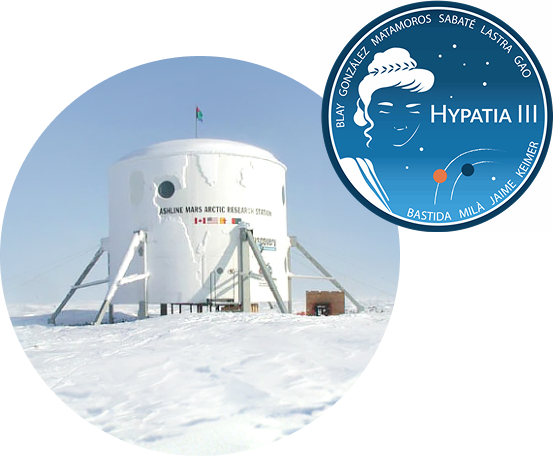
Crew Members





Main Scientific Research Areas
During their mission, the Hypatia III crew will focused on multidisciplinary research to support future human exploration of Mars:

Biology
Research in microbial, plant, and animal sciences aimed at understanding how life could survive, adapt, and thrive in Mars-like environment

Human Factors
Studies focused on the physical, psychological, and social challenges of human life in isolated, confined, and extreme environments similar to Mars

Engineering
Hands-on projects that test and evaluate technologies essential for enabling human life and operations on Mars

International Relations
Fostering global cooperation between institutions, researchers, and students, recognizing that the exploration of Mars is a shared human endeavor

Science Communication
& Outreach
Making space science accessible, inspiring, and inclusive by translating complex research into engaging stories, educational resources, and public dialogue
Research Projects
- Surface Deformation Monitoring at Mars Analog Research Station Using InSAR Techniques (Engineering)
- Strengthening Global Partnerships to Advance Science and Technology with Hypatia (International Relations)
- Letters from the Moon: Lessons from Astronauts for Everyday Human Growth (Outreach and communication)
- Spiritual Health and Perceived Well-Being in Space Crews: A Qualitative Exploration (Human Factors)
- Simulating reduced gravity through 6° inclined sleep (Human Factors)
- Poetry on Mars: Endings and Beginnings (Outreach and communication)
- Fuelling the Future: How personalized nutrition shapes immunity and metabolism in space (Biology)
- Drone-enabled habitat integrity monitoring and positioning system (Engineering)
- Building on Mars: designing habitats with regolith-based materials Project (Engineering)
- Satellite Imagery Station (Engineering)
- Cognitive Health correlations: physiological and metabolic markers (Human Factors)
Site Highlights

Less than 20 crews have performed missions at Flashline

4h by plane from the closest populated area

Less than 50 people live above this latitude

Biggest uninhabited island
Acknowledgements
The Hypatia III mission will be possible thanks to the support of numerous institutions, organizations, and private companies committed to advancing space exploration and STEM leadership.

